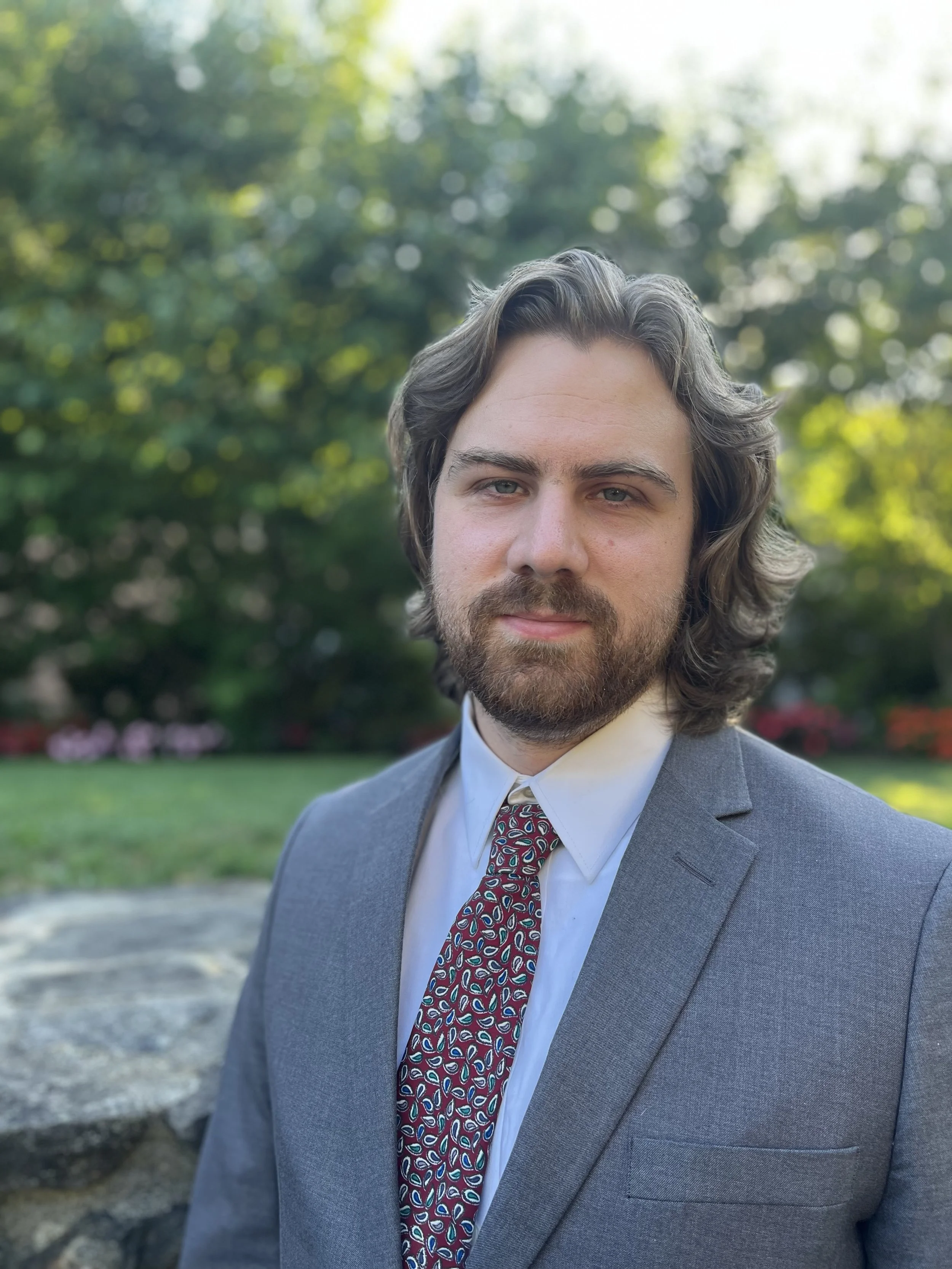
Hello!
A little bit more about me: I grew up in Virginia’s Shenandoah Valley, where clear skies fostered an early love of astronomy & space exploration. I relocated to Greater Boston after earning my undergraduate degree in physics, and gained industry experience before pursuing graduate studies. Building on a fascination with quantum mechanics, quantum information and computation became a major focus, and I’ve since had the opportunity to work with major labs in both theory and experiment. I’ve also pursued interests in software and computation, recently participating in Palantir’s American Tech Fellowship training on their data platform, and recent placed 1st in the Yale Quantum Institute’s YQuantum Hackathon.
Since I was a teenager I’ve never stopped being fascinated by what Eugene Wigner termed “the unreasonable effectiveness of mathematics in the natural sciences”. The capacity of theories and models to predict (or be refuted by) reality is at the center of my intellectual and professional pursuits. My undergraduate thesis reflected this, investigating the strengths and shortcomings of numerical methods in solving physically significant differential equations. Scott Aaronson describes computer science as “what mediates between the physical world and the Platonic World [of ideal mathematical forms]” (Quantum Computing Since Democritus, p. 200) and I am strongly motivated by (but not uncritical of) this conception.
In engineering work following college, I enjoyed contributing to manufacturing, building intuition for sensor physics, and gaining exposure to the family trade (enterprise sales). Pursuing graduate school in physics, I was an intern with BAE Systems’ FAST Labs and Raytheon BBN Technologies, and particularly enjoyed Dr. Pran Nath’s Quantum Theory course sequence. At BBN Technologies I performed experiments with superconducting circuit qubits, gaining valuable experience in electrical engineering methods and cryogenics. This is a leading quantum computing architecture the pioneering development of which won Clarke, Devoret, and Martinis the Nobel Prize in Physics in 2025.
I’m currently prioritizing work at the intersection of theoretical physics, computation, and hardware, for both quantum computing and next-generation sensing. I am motivated by the pursuit of knowledge and excellence for their own sake as well as applications to human flourishing, and I look forward to hearing from you!